What do skin care devices do for the face? They deliver controlled energy, pressure, vibration, or light to the skin’s surface. Their effects depend on the technology, treatment frequency, and your skin’s condition. A cleansing brush may remove surface debris. LED devices may support calmer-looking skin. Microcurrent tools may temporarily improve the appearance of facial contours. At-home exfoliating devices can smooth rough texture, but they may also irritate sensitive skin.
“Skin care devices should complement, not replace, a well-established skin care routine,” says Dr. Joshua Zeichner, a board-certified dermatologist and associate professor of dermatology. His point keeps the discussion grounded. A device can be useful. It is not magic.
Some results are subtle. Think of a brighter forehead after several weeks, or softer cheeks under morning light. Stronger results often require professional treatments, careful settings, and clinical supervision. Home devices usually operate at lower intensities, which improves convenience but may limit their impact. The evidence is also uneven. Some studies are promising, while others involve small groups or manufacturer support.
This article examines what these tools can realistically do for your face. It considers LED masks, cleansing devices, microcurrent tools, and facial massagers. It also addresses comfort, maintenance, skin sensitivity, and safe use. Your expectations may run ahead of the evidence. Mine might, too. A thoughtful routine remains more dependable than an expensive gadget used twice. Consistency matters. So does sunscreen.
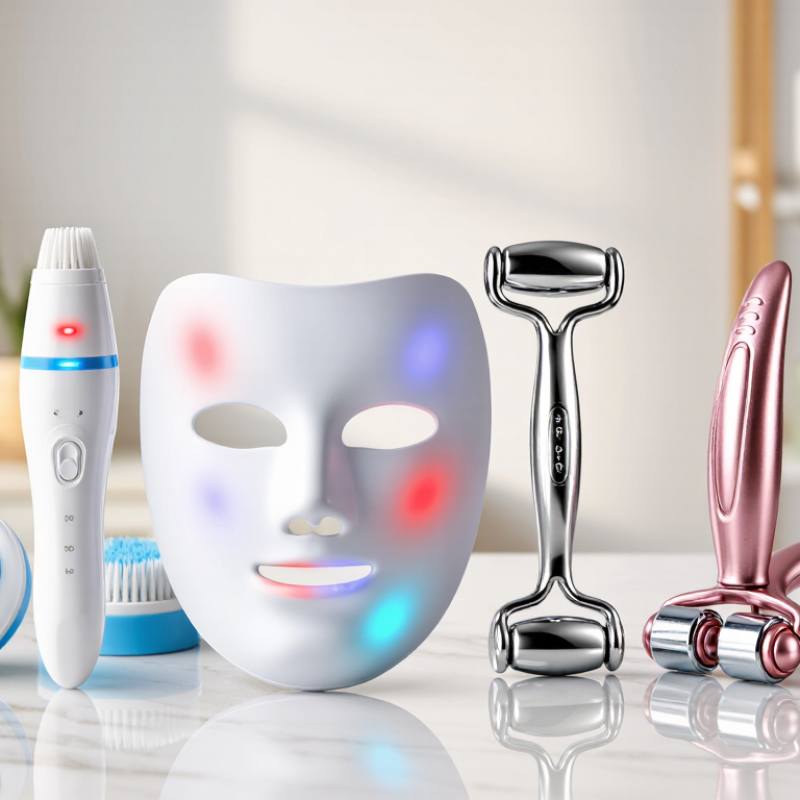
Light, current, heat, and sound affect facial skin in different ways. Light devices use specific wavelengths that reach the skin’s surface or shallow layers. Red light may support a calmer appearance and smoother-looking texture over time. Blue light can target acne-related bacteria, but results vary between users. Consistency matters more than dramatic, overnight changes. Never stare into bright treatment light, and protect your eyes as directed.
Current-based devices deliver a mild electrical flow through the skin. Some users notice temporary tightening or reduced puffiness. Conductive gel often helps the device move comfortably and evenly. People with implanted electronic devices should seek medical advice before using electrical treatments. Heat devices warm facial tissue and may create a short-term firming effect. Excessive heat can cause redness, dryness, or irritation. Sensitive skin needs extra caution.
Sound-based tools use vibration or ultrasonic energy. They may help spread products or loosen surface debris, depending on the device. Evidence for deeper skin changes remains less consistent. That part deserves honest skepticism. A device cannot replace sunscreen, gentle cleansing, sleep, or treatment from a qualified dermatologist. I have also found that “stronger” does not mean “better.” Short sessions, clean skin, and careful monitoring are more sensible. Stop if burning, swelling, or persistent discomfort appears. Photographing the skin under the same light can reveal gradual changes, although even that method is imperfect.
LED therapy devices use specific wavelengths to influence skin without needles or heat. The most discussed options are 415 nanometre blue light and 633 nanometre red light. They do different jobs.
Blue light at 415 nm is commonly studied for mild, inflammatory acne. It may affect acne-related bacteria near the skin surface and reduce some breakout activity. It does not remove oil plugs instantly. A small handheld device will not replace cleansing, prescribed treatment, or professional assessment. Irritation can still happen, especially around the nose and mouth.
Red light at 633 nm reaches deeper layers than blue light. Research suggests it may support cellular activity and calm visible redness. Some studies also report benefits for fine lines and skin texture, but results vary with dose, distance, and treatment time. More light is not automatically better.
Use clean, dry skin and follow the device instructions closely. Protect the eyes when directed, even if the light feels gentle. I would take weekly photos in the same bathroom lighting, because memory exaggerates change. That method is imperfect, but useful. Stop if burning, swelling, or persistent discomfort appears. People using photosensitising medicines or managing a significant skin condition should ask a qualified clinician before treatment. Consistency matters, though patience is often the hardest part.
Microcurrent and EMS: Effects of Low-Level Electrical Stimulation
Skin-care devices using microcurrent or EMS deliver small electrical impulses through conductive pads. Microcurrent usually uses very low current. EMS uses stronger pulses to trigger visible muscle contractions. The sensations differ: gentle tingling versus rhythmic twitching. Users often expect lifting, but the biological story is more modest. Stimulation may temporarily improve muscle tone, circulation, and facial appearance. It does not rebuild collagen overnight. The 2023 ISAPS Global Survey recorded more than 19.5 million nonsurgical aesthetic procedures worldwide. That number shows strong demand, not proof that home devices work.
Peer-reviewed reviews describe the evidence as limited and inconsistent. Small studies often use different waveforms, treatment schedules, and outcome measures. That makes direct comparisons difficult. Some participants report firmer-looking cheeks after several weeks. Others notice little change. I would not call that a facelift. Results may depend on age, skin laxity, device settings, and consistent use. Improper contact can cause discomfort, redness, or minor irritation. Avoid broken skin, and seek medical guidance with implanted electronic devices or pregnancy.
Tips: Apply the recommended conductive gel evenly. Keep the device moving slowly. Never increase intensity to chase faster results. Photograph your face under the same lighting. Stop if you feel pain, burning, dizziness, or prolonged redness. Follow the manual, and ask a qualified dermatologist before treatment. The evidence still feels uneven, so modest expectations are sensible.
What Do Skin Care Devices Do for Your Face?
Radiofrequency and ultrasound devices convert electrical energy into controlled heat. Radiofrequency usually warms tissue through electrical resistance. Ultrasound sends mechanical waves through tissue, often at 1–3 MHz. At 1 MHz, ultrasound has a wavelength near 1.5 millimeters in soft tissue. At 3 MHz, it is closer to 0.5 millimeters. Frequency changes how energy is absorbed. It does not guarantee deeper treatment.
Clinical literature commonly places collagen-remodeling temperatures around 40–45°C. A review in the Journal of Cosmetic and Laser Therapy found that controlled heating may support collagen contraction and new collagen formation. However, home devices usually deliver less energy than clinical systems. Their results may be subtler.
Heat must feel controlled.
In practice, skin can become temporarily red, warm, or tender. Excessive exposure may cause burns, uneven pigmentation, or irritation, especially on sensitive skin. The U.S. Food and Drug Administration emphasizes correct use, device clearance, and attention to safety instructions for energy-based equipment. A 2023 review in Clinical, Cosmetic and Investigational Dermatology also noted that outcomes vary with frequency, power, contact, cooling, and treatment time. That variability matters. Some online claims sound more certain than the evidence allows. Clean skin, steady movement, and avoiding damaged areas are sensible precautions. Yet even careful technique cannot make every device suitable for every face.
Radiofrequency (RF) uses alternating electromagnetic energy, while ultrasound uses mechanical sound waves. This chart shows how ultrasound wavelength changes across the 1–3 MHz range.
Values are calculated using an approximate soft-tissue sound speed of 1,540 m/s: wavelength = sound speed ÷ frequency. Higher frequency produces a shorter wavelength, but heating also depends on power, exposure time, coupling, and tissue properties.
What Do Skin Care Devices Do for Your Face?
Clinical evidence is uneven. A 2023 review in Photodermatology, Photoimmunology & Photomedicine found that LED light may reduce mild acne, but studies were small and used different treatment schedules. Radiofrequency can temporarily improve skin firmness by heating deeper tissue. Microcurrent mainly creates short-term muscle stimulation and visible lifting. These effects are subtle, not surgical. They also vary with age, pigmentation, medication, and technique.
Safety depends on the device and its intended use. The FDA classifies medical devices as Class I, II, or III, based mainly on risk controls, not beauty results. Class I generally presents lower risk; Class II needs additional controls; Class III supports the highest-risk products. FDA clearance, including 510(k) clearance, does not guarantee every marketing claim works. Check the exact indication. Not just the package promises. Risks include burns, irritation, eye injury, pigment changes, and infection after skin-penetrating procedures. Home users may apply too much heat or pressure without noticing.
Market demand is expanding. The International Society of Aesthetic Plastic Surgery reported more than 19 million nonsurgical aesthetic procedures worldwide in 2023. That figure shows popularity, not proven effectiveness. In practice, a cooler, calmer face can look improved after treatment, yet temporary redness may be mistaken for progress. I would record photographs under identical lighting and stop when discomfort appears. Evidence still has gaps, especially for darker skin tones, long-term home use, and combined devices.
| Device type | Primary facial use | Clinical evidence and expected results | Common risks and safety considerations | Typical FDA classification or regulatory note |
|---|---|---|---|---|
| LED phototherapy | Red or near-infrared light is used mainly for mild inflammatory acne, redness, and signs of photoaging. Blue light is commonly used for acne-related bacteria. | Moderate for acne; limited to moderate for photoaging. Studies generally report modest improvement after repeated treatments over several weeks. Results are usually gradual and less pronounced than those from prescription treatment or in-office procedures. |
Temporary redness, dryness, irritation, headache, or eye discomfort may occur. Eye protection may be needed. Photosensitizing medicines and light-sensitive conditions require professional advice. | Many therapeutic light devices are regulated as Class II medical devices when marketed for specific indications. Classification depends on the wavelength, intended use, and product claims; cosmetic light products may have different regulatory status. |
| Microcurrent or electrical stimulation | Low-level electrical current is marketed for temporary muscle stimulation, facial contouring, or a more toned appearance. | Limited and generally short-term evidence. Small studies suggest temporary changes in facial appearance, but durable wrinkle reduction or lifting has not been established as strongly as for some medical procedures. |
Tingling, skin irritation, redness, discomfort, or headache. Avoid use over implanted electronic devices, such as pacemakers, and seek medical advice during pregnancy or with seizure disorders. | Electrical stimulation devices with therapeutic claims are commonly Class II, but the exact FDA pathway depends on intended use. A cosmetic product may not have the same clearance or evidence requirements as a medical device. |
| Radiofrequency (RF) | Controlled heating of the dermis is intended to support collagen remodeling and improve mild skin laxity or wrinkles. | Moderate evidence for modest improvement. Professional and some home-use studies report gradual changes in skin firmness and fine lines. Multiple sessions are often needed, and results vary by energy level, treatment protocol, and skin characteristics. |
Pain, redness, swelling, burns, pigment changes, fat loss, or scarring are possible, particularly with excessive heat or incorrect technique. Extra caution is needed with metal implants and darker skin types because of pigment-change risk. | RF devices intended to heat tissue or treat wrinkles are often Class II. FDA clearance indicates substantial equivalence for a specified intended use; it does not guarantee effectiveness for every cosmetic claim. |
| Ultrasound or focused ultrasound | Ultrasound energy may be used for temporary skin tightening or to stimulate deeper tissue remodeling. | Moderate evidence for selected professional treatments; limited evidence for many home devices. Improvement, when present, is generally gradual and modest. Treatment depth and energy delivery strongly affect both results and risk. |
Tenderness, swelling, bruising, temporary numbness, nerve irritation, burns, or unintended tissue injury may occur. Incorrect placement around the eyes, nerves, or other sensitive areas can be hazardous. | Certain therapeutic ultrasound systems are Class II or Class III depending on the intended use and risk profile. FDA classification is product-specific and should not be inferred solely from the technology name. |
| Microneedling | Fine needles create controlled micro-injuries to support collagen remodeling and improve acne scars, texture, and fine lines. | Moderate evidence for acne scars and texture when performed with appropriate medical protocols. Improvement usually requires a series of treatments. Home rollers and low-depth devices may produce less improvement and can create additional hygiene or technique problems. |
Bleeding, infection, prolonged redness, acne or herpes flare, post-inflammatory hyperpigmentation, and scarring are possible. Sharing devices or using nonsterile cartridges increases infection risk. | FDA classification varies by device design and intended use. Some powered microneedling devices have been reviewed as Class II devices, while certain cosmetic needling products may not be cleared for medical claims. FDA clearance does not establish that every use is safe. |
| Intense pulsed light (IPL) | Broad-spectrum flashes may be used for selected pigmentation, redness, unwanted facial hair, and some photoaging concerns. | Moderate evidence for specific indications under controlled conditions. Results depend on the target, skin tone, wavelength settings, and treatment schedule. It is not the same as a laser and is not suitable for every pigmentation concern. |
Pain, redness, blistering, burns, eye injury, temporary or permanent pigment changes, and paradoxical hair growth are possible. Risk is higher with recent tanning, photosensitizing drugs, or inappropriate settings. | IPL systems used for medical indications are generally Class II. Clearance is indication-specific, and many systems require trained operators. At-home products may use lower energy but can still cause burns or eye injury. |
| Laser resurfacing or fractional laser | Laser energy is used to treat wrinkles, photodamage, scars, selected pigmentation, and uneven texture by controlled thermal injury. | Moderate to strong evidence for selected professional treatments. Fractional ablative treatments can produce meaningful improvement in texture and scars, while nonablative treatments generally provide subtler results with less downtime. |
Redness, swelling, infection, acne or herpes reactivation, pigment changes, burns, and scarring may occur. Darker skin types may have a higher risk of prolonged hyperpigmentation with some settings. | Medical lasers are commonly Class II or Class III depending on wavelength, power, and intended use. A cleared device must still be used only for its authorized indications and according to professional safety requirements. |
| Vacuum, suction, or mechanical exfoliation | These devices remove surface debris or temporarily increase superficial blood flow and are used for cleansing, exfoliation, or short-term smoothing. | Limited evidence for durable cosmetic change. They may produce temporary smoothness or brightness, but they do not reliably remodel deeper collagen or permanently reduce wrinkles. |
Irritation, bruising, broken capillaries, abrasions, worsening rosacea, or post-inflammatory pigment changes may occur, especially with strong suction or repeated passes. | Regulatory status varies widely. Some products may be Class I, exempt, or marketed only for cosmetic cleansing, while products making therapeutic claims may require a different regulatory pathway. |
Different wavelengths reach the surface or shallow layers. Red light may support calmer-looking skin and smoother texture. Blue light may target acne-related bacteria. Results differ between users. Progress is usually gradual.
Do not stare into bright treatment light. Follow the device’s eye-protection instructions carefully. Stop if eye discomfort or unusual vision changes appear.
They deliver small electrical impulses through conductive pads. Microcurrent usually feels like gentle tingling. EMS can cause rhythmic muscle twitching. Some users notice temporary firmness or reduced puffiness.
No. That expectation is too strong. These devices do not rebuild collagen overnight or replace professional procedures. Evidence remains limited and inconsistent. Some people notice little change.
Apply the recommended conductive gel evenly. Keep the device moving slowly across clean skin. Do not raise intensity to chase faster results. Stronger is not always better.
People with implanted electronic devices should ask a qualified medical professional first. Pregnancy also requires medical guidance. Avoid using electrical devices on broken skin.
Heat warms facial tissue and may create short-term firmness. Too much heat can cause redness, dryness, or irritation. Sensitive skin needs extra caution. A warm face is not proof of better results.
Vibration or ultrasonic energy may spread products or loosen surface debris. Evidence for deeper changes is less consistent. Healthy skepticism is reasonable here. More research is still needed.
Photograph your face under the same lighting each time. Compare changes after several weeks, not overnight. This method is imperfect, but useful. Stop for burning, swelling, dizziness, pain, or prolonged redness.
What do skin care devices do for the face? They use controlled forms of light, electrical stimulation, heat, or sound to support common skin-care goals. LED therapy may use approximately 415 nm blue light to target acne-related bacteria, while 633 nm red light is commonly studied for supporting a calmer appearance and the skin’s natural repair processes. Microcurrent and EMS devices deliver low-level electrical signals that may temporarily stimulate facial muscles and improve the look of tone and firmness.
Radiofrequency and ultrasound technologies use energy in the 1–3 MHz range to warm selected skin layers, potentially encouraging collagen-related processes and creating a smoother appearance over time. However, results vary according to the device, treatment schedule, skin type, and individual response. Safety is equally important: excessive heat, improper use, or unsuitable electrical stimulation may cause irritation or discomfort. Consumers should follow instructions, protect sensitive skin, and understand that device classifications and clinical evidence differ. These tools can complement, but not replace, professional advice or a consistent basic skin-care routine.
